Valentine Cup · From the archive
A history of
the Valentine Cup
For more than a century, the Valentine Cup has been part of the story of amateur rugby league in Salford and the wider Manchester district.
Local clubs. Lasting rivalries. A new chapter.
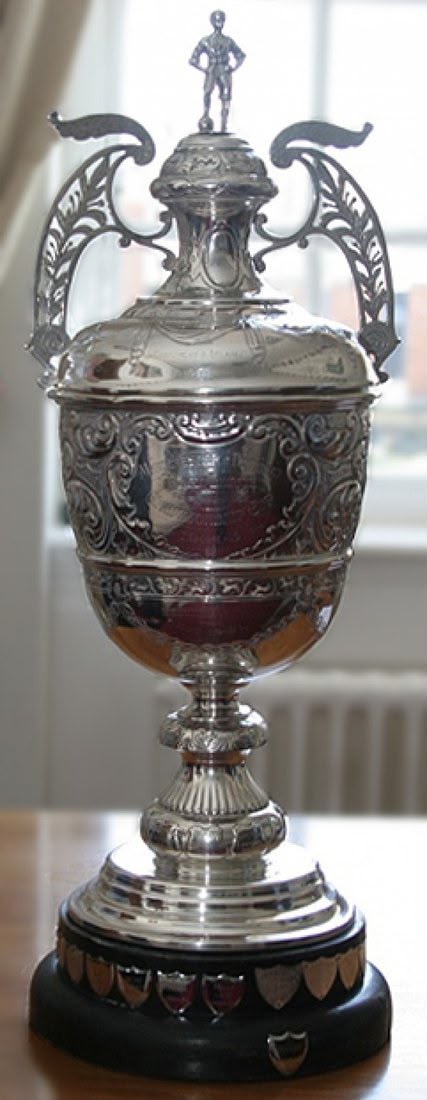
The trophy itself dates from the beginning of the twentieth century. Made by Fattorini and Sons, it bears the inscription “Manchester and District Rugby League Championship Cup 1902-03”, along with an earlier reference to the Manchester & District League being reorganised in 1898. The first club recorded on the cup itself was Egerton, winners in 1902/03.
The early years
The cup began life as the championship trophy of the Manchester & District Rugby League, at a time when rugby league was organised through much more local competition than it is today.
The early decades provide a roll call of clubs from communities across Salford, Manchester and the surrounding districts. Egerton and Radcliffe Rangers were prominent in the first years, while Cadishead & Irlam, Pendlebury, Rylands Recreation, Healey Street (Oldham), XII Apostles (Leigh), Swinton St Peter’s, Seedley Rangers and Chloride Recreation all feature in the surviving records.
Rylands Recreation took the trophy to Warrington in the years before the First World War, while Healey Street (Oldham) later became another winner from outside the immediate Manchester area. The surviving records also show that the competition did not run continuously: there were a number of gaps even before the disruption caused by the Second World War.
Rugby league after the war
The post-war years brought another chapter in the competition’s history.
Langworthy became one of the leading names associated with the trophy, while Salford Juniors, Swinton Juniors and Kearsley Juniors also enjoyed success. Contemporary newspaper research confirms that the Valentine Cup was being contested during the 1950s, with matches involving clubs such as Langworthy, Seedley Rangers, Kearsley, Salford Juniors and Broughton Rangers.
By this period the competition was increasingly becoming the local knockout cup remembered by later generations of players and supporters, rather than simply the championship trophy of the original Manchester & District League.
Langworthy and the rise of Folly
Langworthy became a major force again from the end of the 1950s and into the 1960s.
The next great period of dominance came with Folly Lane during the 1970s. The club established itself as one of the strongest amateur sides in the district and the Valentine Cup became an important part of that success.
Langworthy eventually broke Folly’s hold on the competition at the beginning of the 1980s, taking the trophy in 1980/81 and retaining it the following season.
A new generation of winners
The 1980s brought new names to the trophy.
Irlam Hornets recorded their first success in 1982/83, with Eccles following the next season. Folly Lane returned to winning ways in 1984/85 after a remarkable campaign that included victories of 102–0 against Irlam Town and 106–0 against Stockport before the final against Langworthy.
Irlam Hornets went on to become the dominant side of the late 1980s and early 1990s, during an era when local rivalry and the right to call yourself the best amateur side in the district gave the Valentine Cup real significance.
One of the most memorable contests came in the 1991/92 semi-final against Langworthy. The match went to extra time, with five Alan Marsh drop goals helping Irlam control the additional period. Hornets subsequently defeated Folly Lane 18–14 at Station Road in what was one of the final matches played at the famous former Swinton ground.
Decline and periods of inactivity
By the late 1990s, changes in the amateur game were beginning to make the competition increasingly difficult to organise.
Some clubs were competing at different levels and in different leagues, while others were reluctant or unable to enter. At one stage only Eccles, Langworthy and Folly Lane were competing for the trophy on a round-robin basis. There were seasons in which no competition took place at all.
Eccles remained a major force during this period, while Folly Lane continued to feature prominently.
Attempts were made to keep the competition alive as a pre-season tournament in the early 2000s. In 2002/03 a proposed final between Eccles and Folly Lane was never played after the clubs were unable to agree a suitable venue and date.
The cup returns — and disappears again
After another lengthy break, the Valentine Cup was revived in 2009.
Folly Lane defeated Cadishead Rhinos in one semi-final while Irlam Hornets overcame Langworthy Reds in the other. The final was staged at The Willows on 26 August, where Folly Lane defeated Irlam Hornets 22–20.
The competition was staged again during the following years, with the final recorded contest taking place in 2011/12, when Eccles defeated Irlam Hornets 26–20.
Then the Valentine Cup disappeared from the calendar once more.
2026 · The revival
A new chapter
In 2026, the Valentine Cup returns.
Its revival brings together four of Salford’s community rugby league clubs and reconnects today’s players with more than a century of local sporting history.
The clubs have changed. The structure of amateur rugby league has changed. Grounds that once hosted famous Valentine Cup matches have disappeared.
But the idea behind the competition remains powerful: local clubs competing for a trophy that generations of Salford and Manchester rugby league players have wanted to win.
The 2026 competition therefore represents more than the return of an old cup.
It is the beginning of its next chapter.
Research & editorial notes
With thanks to Graham Morris and Kenny Roberts for the historical research. This article uses the edited website copy alongside the project notes, historical article, programme content and current Roll of Honour.